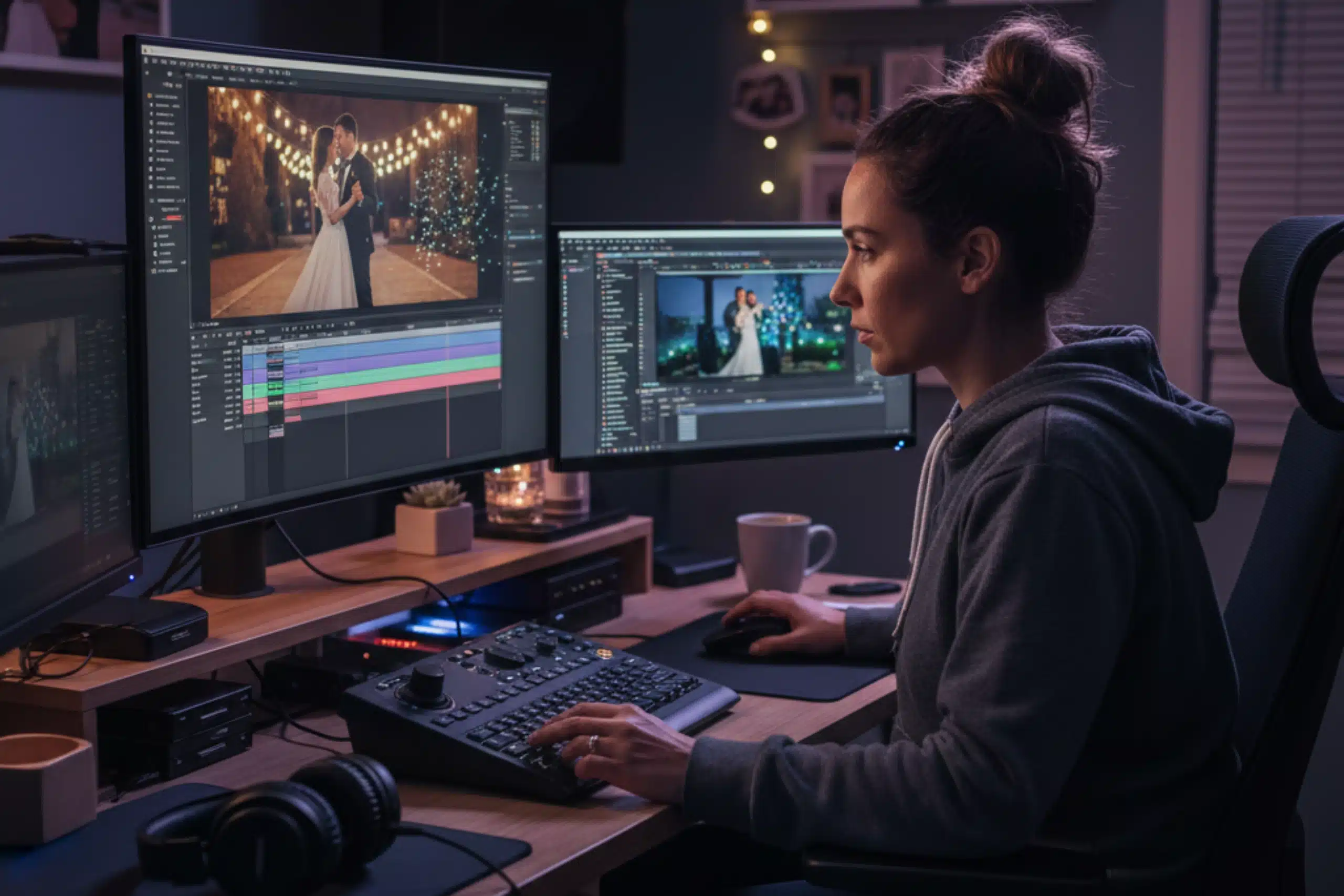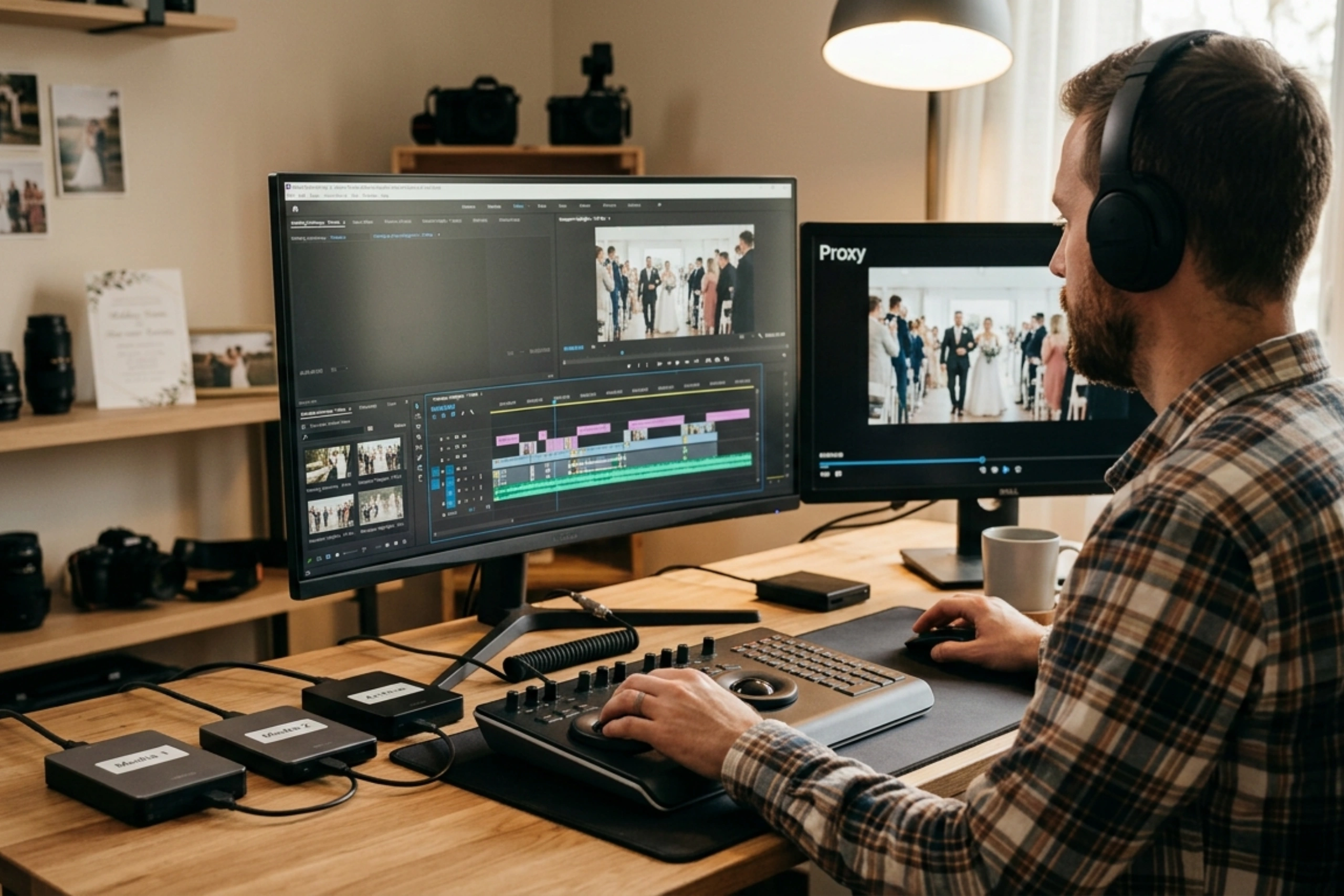
For wedding videos, turnaround time is as important as cinematic quality in the USA. Nowadays, couples and families don’t want to wait for months to receive wedding films as they need to share their precious moment on Instagram, TikTok, and other social platforms. It increases the pressure on Videographers to deliver faster wedding movie editing without sacrificing quality.
But there’s a problem.
Modern weddings generate enormous amounts of data. An average 4K wedding in the United States can easily produce 500GB to 1.5TB of footage in a single day using three to five cameras. When you include slow-motion clips, drone footage, and external audio, post-production suddenly stops being a creative process and turns into a technical bottleneck.
At Motion Edits, we discovered that creativity wasn’t the main cause of wedding video editing delays. It was workflow inefficiency.
At that point, we used proxy workflows to redesign our editing pipeline, which resulted in a 42% reduction in the average wedding film delivery time.
Check Our Wedding Video Editing Service
The Original Problem: Heavy Footage Was Slowing Everything Down
Editors were working directly with original camera files before the implementation of proxy workflows. While some high-end clients requested 6K or RAW formats, the majority of weddings were delivered in 4K.
This led to significant problems with playback. Timeline lag, delayed scrubbing, slow rendering, and playback stuttering during multi-cam editing have been reported on even the most advanced editing systems.
For every wedding project, editors were losing 8 to 12 hours on average just waiting for the footage to react properly.
This became a major operational problem for a studio that handles 20–30 weddings a month.
What Changed: Introducing Proxy-Based Wedding Editing
Lightweight versions of the original video files are produced by a proxy workflow so that editing software can handle them more easily. While the software keeps links to the original footage, editors work with optimized low-resolution copies rather than directly editing large camera files.
At Motion Edits, we implemented 1080p proxy generation for all 4K/6K footage, automated overnight proxy creation, shared folder structures for editors, and organized multi-cam proxy timelines.
The outcome was instantaneous. Editors were able to navigate footage without continuous playback interruptions, and timeline responsiveness increased by almost 65%. Every step of the wedding video editing process was greatly accelerated by this.
Multi-Cam Syncing Became Faster and More Stable
Most U.S. wedding shoots today involve 3–5 camera angles, drone footage, multiple audio sources, and separate ceremony recordings.
Depending on the complexity of the footage, synchronizing big multi-camera projects could take two to four hours per wedding before optimization.
Synchronization time decreased by about 40% following the integration of proxy workflows and optimized audio waveform syncing.
This meant that rather than spending hours dealing with technical delays, editors could move much more quickly into creative storytelling. Delivery capacity is directly impacted by workflow speed for professional wedding film editors.
Editors Could Handle More Weddings Without Burnout
One editor could easily handle six to eight high-end wedding films each month before the new system.
After workflow optimization:
- Editors handled 10–12 weddings monthly
- Revision turnaround improved by 35%
- Export failures dropped significantly
- Overnight rendering became more stable
Motion Edits increases its outsourced wedding video editing capacity without compromising quality, thanks to this operational change. More significantly, editors focused more on storytelling and less on troubleshooting.
Color Grading Became More Consistent Across Projects
Inconsistent footage from various cameras is one neglected problem in wedding movie editing. A typical wedding may combine Sony mirrorless cameras, Canon cinema footage, DJI drone clips, and Slow-motion footage in different codecs. Color grading is greatly slowed down when all of these formats are matched without an appropriate workflow structure.
Motion Edits wedding video editor world with proxy-linked color pipelines, shared grading references, and LUT-based camera normalization.
This improved consistency across projects and cut the average color correction time by about 25–30%.
For videographers, this implies that every wedding video maintains the same brand style.
Export Optimization Reduced Delivery Delays
Today, wedding delivery is done on multiple platforms. Full cinematic films, Instagram reels, vertical teaser cuts, Vimeo exports, YouTube versions, and client download files are now required by videographers. In the past, rendering errors and repeated exports caused export management to add several hours to delivery schedules.
Motion Edits optimizes render queue automation, platform-specific compression settings, and export presets. As a result, each project’s final export and upload times were shortened by about 30%.
This operational improvement became very valuable for studios that handled large numbers of weddings.
Why This Matters for Wedding Videographers
The most important takeaway from this workflow modification is straightforward:
- The majority of videographers don’t genuinely struggle with editing. They have an issue with their system.
- Because their workflows were never built for scale, many gifted creators lose time. Technical inefficiencies compound quickly as wedding businesses expand.
- Professional wedding video editing services now focus on operational efficiency rather than just editing prowess.
That’s exactly where Motion Edits helps.
How Motion Edits Supports Scalable Wedding Businesses
At Motion Edits, our goal is to create systems that allow videographers to scale sustainably.
By using structured editing pipelines, optimized proxy workflows, and cooperative post-production support, videographers can:
- Reduce delivery time
- Increase booking capacity
- Maintain cinematic quality
- Avoid editing burnout
- Focus more on shooting and business growth
Putting in more hours is not the key to growing a wedding business. The goal is to create more intelligent workflows.
Conclusion
Because editors worked harder, a 42% reduction in wedding film delivery time was not achieved. It occurred as a result of the workflow becoming more intelligent. Post-production was transformed from a bottleneck into a scalable system through the use of proxy editing, structured pipelines, optimized exports, and cooperative outsourced wedding video editing.
Additionally, systems are what distinguish expanding studios from overburdened freelancers in today’s wedding industry.
Check Our Wedding Video Editing Service
FAQs
1. What is a proxy workflow in wedding video editing?
Lightweight versions of large video files are used in a proxy workflow to enhance timeline performance and editing speed for wedding videos.
2. How do proxy workflows improve wedding film delivery time?
Proxy workflows help editors produce films more quickly by lowering playback lag, enhancing multi-cam editing performance, and accelerating rendering.
3. Why do wedding videographers use outsourced wedding video editing?
To lessen workload, speed up turnaround times, and effectively manage higher wedding volumes, videographers use outsourced wedding video editing.
4. What technical tasks slow down wedding videography editing?
Significantly time-consuming tasks include large footage sizes, multi-camera syncing, audio alignment, color correction, rendering, and export management.
5. How does Motion Edits help wedding videographers scale?
Motion Edits helps videographers develop effectively by offering professional wedding film editing support, proxy-based systems, and optimized editing workflows.